第十一章 录入-变换-即时追改
本章介绍一些特殊的录入技巧、变换技巧和 E 迅速记独有的即时追改功能。
第一节 录入技巧
以下几个录入技巧在关键时刻会很有用处,请勿忽视。
一、重复录入刚才内容
对于需要重复录入的即时内容,可按功能键 F:chong 来实现,具体如下:
当缓冲行有内容时,重复最后一击录入内容;
当缓冲行无内容时,重复前一次上屏的内容。
11 Real-time Conversion and Editing
This chapter introduces several specialized input methods and editing techniques, and EXun's real-time editing feature.
11–1 Input Techniques
The input techniques below will prove very useful at critical moments; please do not overlook them.
1. Repeat entered text
For real-time content that requires repeated entry, you can use the outline F:chong:
If there is text in the buffer, repeat the text entered in the last stroke;
If the buffer is empty, repeat the last text committed to the document.
重复录入刚才内容
Repeat entered text |
F:chong |
二、联想录入目标内容
2. Predictive Input
This section has been omitted due to being irrelevant to theory.
三、一键录入日期时间
- 按功能键
F:ri 可以快速录入当前日期,且有多种格式可选。
          >2022年3月9日
           二〇二二年三月九日
- 按功能键
F:shi 可以快速录入当前时间,且有多种格式可选。
          >下午4点22分
           [16:22:38]
           4点22分
           16时22分38妙
           十六点二十二分
- 按功能键
F:FBI 可以快速录入当前日期和时间,并直接上屏。
>【2016-09-08 01:53:57】
3. Date and Time Input
- Writing
F:ri inserts the current date, with a variety of formats to choose from:
          >2022年3月9日
           二〇二二年三月九日
- Writing
F:shi inserts the current time, also with a few format options:
          >下午4点22分
           [16:22:38]
           4点22分
           16时22分38妙
           十六点二十二分
- Writing
F:FBI inserts the current date and time and commits it directly to the document:
>【2016-09-08 01:53:57】
当前日期
current date |
F:ri |
当前时间
current time |
F:shi |
当前日期和时间
current date and time |
F:FBI |
上述用文字形式输出的时间,并非规范的时间标记,不能用于快速检索、校对、剪辑等后期制作工作。
四、快速录入常用网址
得益于词库的灵活架构,我们在词库里增加了近万个网址,以实现常用网址的便捷录入。
此外,我们还预设了若干个与网址录入相关的直击内容,其打法如下:
The timestamps shown above are not standard time indicators and cannot be used for post-production tasks like proofreading or editing.
4. Commonly Used URL Input
Thanks to the flexible architecture of our vocabulary database, we have nearly 10,000 URLs to make entering frequently used URLs easier.
We have also assigned direct-input outlines specifically for URLs, which are as follows:
功能键
Outline |
直击内容
Outputs |
DN:B | http:// | https:// | |
DN:F | www. | ftp. | |
DN:FG | .cn | .tw | .hk |
DN:BG | .com | .com.cn | |
DN:IRF | .net | .net.cn | |
DN:IHL | .org | .org.cn | |
DN:IRA | .gov | .gov.cn | |
DN:IRN | email | 邮件地址 | |
五、五笔画录入生僻字
该功能主要用来录入生僻字,它以传统的五笔画为基础码元。
五笔画,即横(提)、竖(竖勾)、撇、点(捺)、 折五种笔画,是构成汉字最基本的元素。任何一个字都可以拆分为这五种笔画。
我们为五种笔画分别安排了不同的编码,均为双手操作, 左手编码分别与其读法一致,右手为固定编码 BOU。此外还设置了一套快捷键,左手编码与两笔码(详见第十二章第三节)的五个单笔画相一致,大家可根据喜好选用。
5. Stroke-based Input
This feature is mainly intended for writing rare or obscure characters; it uses the traditional five strokes.
The five strokes are the basic components of Chinese characters: 一 heng (including ㇀ ti), 丨 shu (including 亅 shugou), 丿 pie, 丶 dian (including ㇏ na), and 乛 zhe. Any character can be decomposed into these five strokes.
We have assigned specific chords to these strokes for two-handed writing. The chords for the left hand correspond to the name for each stroke, while the right hand is the designator :BOU. We have also implemented an alternative set of outlines where the left-hand chords match those in two-stroke input (see Chapter 12, Section 3); you may use whichever set of outlines you prefer.
Note: The table in the book has the outlines for both 点 and 捺 as pie:BOU; this may be a typesetting error.
笔画
Stroke |
编码
Outline |
快捷键
Brief |
一
横 horizontal |
heng:BOU |
AN:BOU |
丨
竖 vertical |
shu:BOU |
OU:BOU |
丿
撇 left-falling |
pie:BOU |
AO:BOU |
丶
点 dot |
pie:BOU
(dian:BOU?) |
NG:BOU |
㇏
捺 right-falling |
pie:BOU
(na:BOU?) |
乛
折 hook |
zhe:BOU |
OU:BOU |
例如:连续录入撇、撇、折、横、横的编码,就可以打出“甪”字。输入条缓冲行还会提示其读音。
          >甪  读音: lu
           殷
           慇
注意,无论是否生僻字都可以用五笔画录入,只要按照笔画顺序连续录入相应编码,就能打出想要的字。
For example, you can write 甪 using its first five strokes, 丿丿乛一一. The input bar also shows its pronunciation:
          >甪  读音: lu
           殷
           慇
Note that the five-stroke input method can be used to write any character, no matter how common. By entering the corresponding outlines in order, following the correct stroke order, you can enter the specific character you want.
六、文字一键转为拼音
按功能键可 F:pin 以让前一击录入的文字内容转换为拼音串,且有多种格式可选。比如:先录入了“吃拿”的音节码:
>吃拿 吃那 吃哪 持那 持哪 痴哪
再按功能键 F:pin,则将其转换为以下三种可选格式:
>china chi'na' [音:chi'na']
大家偶尔也可以用这种方式来快速录入某些特定英文单词。
6. Pinyin Input
Writing the outline F:pin translates the text entered in the previous stroke to a Pinyin string, with various formats available. For example, if you write the phonetic chords for 吃拿:
>吃拿 吃那 吃哪 持那 持哪 痴哪
Writing F:pin converts this input to the following:
>china chi'na' [音:chi'na']
You can use this to occasionally write specific English words.
第十二章 首尾-声调-两笔形码
首尾码除了能作为辅码选重,还可用来录入单字,尤其是生僻字;反之,声调码除了能录入声调直击字,还可用作字词选重的关键信息;两笔码也是既能用作辅码选重,还能用来录入单字。本章介绍的三项内容,虽因直观性不足、反应负担大,导致使用较少,但其原理和思路颇有精妙之处,非常值得大家学习。
12 Shape-based Input
In addition to being used as auxiliaries for disambiguation, head-and-tail chords can also be used to write individual characters, and particularly rare ones. Meanwhile, while tone chords allow for direct entry of specific characters based on their tones, they also provide crucial information for disambiguating characters and phrases. Similarly, two-stroke chords take on two roles, as auxiliary chords for disambiguation or for direct input of characters. Although the three methods introduced in this chapter are used less frequently, due to the lack of intuitiveness and significant cognitive load, the principles behind them are worth studying.
第一节 首尾码
在第七章《辅码与选重》中,我们已经学过用首尾辅助码筛选字词的功能。本节介绍用首尾切形码录入生僻字的功能,以及用音形结合的拓展首尾码进一步筛选重码单字的功能。
12–1 Head-and-Tail Chords
In Chapter 7, "Auxiliary Chords and Disambiguation", we learned how to use head-and-tail auxiliary chords to disambiguate characters and phrases. This section introduces the use of head-and-tail chords for writing rare characters, as well as extending that application to further disambiguate characters.
一、首尾切形码
看打过程中,难免会遇到一些生僻字,只知道怎么写,不知道怎么读。遇到这样的拦路虎,与其停下来去查找其读音,不如试试首尾切形码。
顾名思义,首尾切形码就是根据汉字的结构,以最直观的方式将其切成的首、尾两块,然后反过来通过首码和尾码的组合来录入该汉字。它需要两击完成,其功能键为:
1. Head-and-Tail Component Chords
When writing from hard-copy material, you inevitably run into the problem of writing certain rare or obscure characters, ones you may know how to write but not how to pronounce. Rather than pausing to look up how to pronounce them, it is much faster to try using head-and-tail component chords.
As the name suggests, head-and-tail component chords work by structurally decomposing a Chinese character into two distinct parts, an initial (head) component and a final (tail) component. You can then write the chraracter by combining the outlines for those components. This method requires two strokes, and uses the following designators:
譬如:上下结构的“恏”可通过首码“好”和尾码“心”组合出来。具体如下:
第一击:左手录入首码“好”的音节 hao,同时右手录入尾码“心”的音节 xin
>好心 好新 浩鑫 好信
第二击:按功能键 DHN: 或 :DHN
>恏
For example, the character 恏, which has a top-and-bottom structure, can be written by combining its initial component 好 and final component 心. The steps for doing so are:
In the first stroke, write the initial component 好 phonetically with your left hand, and the final component 心 phonetically with your right hand (hao:xin):
>好心 好新 浩鑫 好信
Then in the second stroke, write the designator DHN: or :DHN:
>恏
我们不妨多举几例。
- 左右结构的“翀”可通过首码“羽”和尾码“中”组合出来。 (yu
:zhong)
- 右上包围结构的“匉”可通过首码“勹”(句字框)和尾码“平”组合出来。 (ju
:ping)
- 左上包围结构的“虗”可通过首码“虍”(虎字头)和尾码“丘”组合出来。 (hu
:qiu)
- 左下包围结构的“瓧”可通过首码“瓦”和尾码“十”组合出来。 (wa
:shi)
- 上三包围结构的“囘”可通过首码“冂”(同字框)和尾码“巳”组合出来。 (tong
:si)
- 下三包围结构的“凷”可通过首码“土”和尾码“凵”(画字框)组合出来。 (tu
:hua)
- 左三包围结构的“匜”可通过首码“匚”(区字框)和尾码“也”组合出来。 (qu
:ye)
- 全包围结构的“囲”可通过首码“囗”(围字框)和尾码“井”组合出来。 (wei
:jing)
Let's go through a few more examples:
- The left-right character 翀 can be written with 羽 and 中 (yu
:zhong).
- The top-right enclosing character 匉 can be written with 勹 (the component in 句) and 平 (ju
:ping).
- The top-left enclosing character 虗 can be written with 虍 (the component in 虎) and 丘. (hu
:qiu)
- The bottom-left enclosing character 瓧 can be written with 瓦 and 十 (wa
:shi).
- The top-surrounded character 囘 can be written with 冂 (the component in 同) and 巳 (tong
:si).
- The bottom-surrounded character 凷 can be written with 土 and 凵 (the component in 画) (tu
:hua).
- The left-surrounded character 匜 can be written with 匚 (the component in 区) and 也 (qu
:ye).
- The full-surrounded character 囲 can be written with 囗(the component in 围) and 井 (wei
:jing).
二、妙用与多选
与五笔画类似,首尾切形码不限于录入生僻字,任何可以明显分出首尾部件的字都可以用这种方法来录入。比如:
- “始”可用首码“女”和尾码“台”组合出来。 (nü
:tai)
- “移”可用首码“禾”和尾码“多”组合出来。 (he
:duo)
对于同音重码多且用其他方法难以快速录入的单字,用首尾切形码来巧妙录入,不失为一种好方法。
首尾码部件的来源及其读音基本遵循国家语委 2009 年发布的《现代常用字部件及部件名称规范》 ,只对极个别部件进行了优化,并延续其设计思路适当增加了一些部件。GBK字符集全部汉字均能用首尾码打出来,共计两万多个。但随之而来的一个问题是,很多字都不止一种组合方式。
比如:
- “兊”的首尾码既可以是“公”和“儿” (gong
:er),也可以是“八”和“允” (ba:yun)。
- “洳”的首尾码既可以是“氵”和“如” (san
:ru),也可以是“汝”和“口” (ru:kou)。
- “真”的首尾码既可以是“直”和“ハ” (zhi
:ba),也可以是“十”和“具” (shi:ju)。
- “硎”的首尾码既可以是“研”和“刂” (ren
:dao),也可以是“石”和“刑” (shi:xing)。
不难发现,这些字虽有多种组合可选,但结果可能仍然会有重码。究竟该选哪种首尾切形码才是最优的,需要在实践中大量积累经验才能运用自如。而有的字不管选择哪种组合,都会有重码需要继续筛选。此时,便可使用下面介绍的拓展首尾码。
2. Versatile Applications
Much like the five-stroke input method, head-and-tail chords are not limited to writing rare characters; any character with clearly identifiable head and tail components can be written this way. For example:
- 始 can be written with 女 and 台 (nü
:tai).
- 移 can be written with 禾 and 多 (he
:duo).
For characters with many homophones that are hard to write quickly with other methods, the head-and-tail method offers an ingenious and effective solution.
The readings of the head-and-tail components adhere to the Specification of Common Modern Chinese Character Components and Component Names, published by the State Language Commission in 2009. Only a handful of components have been merged, and a small number of additional components have been introduced. All Chinese characters in the GBK character set, over 20,000 of them, can be written using the head-and-tail method. However, the issue is that many characters can be decomposed in more than one way.
For example:
- 兊 can be written with 公 and 儿 (gong
:er) or 八 and 允 (ba:yun).
- 洳 can be written with 氵 and 如 (san
:ru) or 汝 and 口 (ru:kou).
- 真 can be written with 直 and ハ (zhi
:ba) or 十 and 具 (shi:ju).
- 硎 can be written with 研 and 刂 (ren
:dao) or 石 and 刑 (shi:xing).
As you can see, although each character has multiple possible decompositions, the results may still contain conflicts. Determining which decomposition is optimal requires a lot of experience to master. Furthermore, some characters will inevitably conflict regardless of which option is chosen and require further disambiguation. In those cases, you can use the extended head-and-tail method shown below.
三、拓展首尾码
有些字的首部件读音相同,尾部件读音也相同,导致应用首尾码功能后,仍然存在许多重码。若目标汉字不是首选项,则需要进一步选择。
比如,符合首码读音为 ren、尾码读音为 er 的字有若干个:
>乍 倪 仁 你 侕 佴
如果目标汉字是“仁”,那么还得再选重。
一般来说,这些重码汉字的读音都不尽相同。所以,直接用目标汉字的读音来选重就是最高效的命中方式。有鉴于此,我们提供了一种更快捷的方法——拓展首尾码。即在首尾切形码的基础上,直接加入目标汉字的读音,将录入与选重合二为一,以减少击键次数。其使用方法很简单,就是在一只手按首尾切形码功能键的同时,另一只手录入目标汉字的读音。具体又包括形音码和音形码两种。
1. 形音码
还以“仁”为例进行说明。
第一击:与首尾码相同,双手同时录入首尾切形码“亻”和“二”的音节 ren’er
>人儿 人耳 人而 刃儿
第二击:左手录入“仁”的音节 ren,同时右手按功能键 DHN,则会一击命中。
>仁
3. Extended Head-and-Tail Chords
For some characters where the initial components are pronounced the same as are the final components, several characters can still remain when using the regular head-and-tail method. If the desired character is not the first candidate, further disambiguation is needed.
For example, there are several characters with an initial component pronounced ren and a final component pronounced er:
>乍 倪 仁 你 侕 佴
Writing the character 仁 would require another disambiguation step.
Generally speaking, these characters do not tend to be pronounced the same, so it should be possible to use the pronunciation of the target character to get an exact match. With this in mind, we have developed the extended head-and-tail method, which integrates the pronunciation of the desired character into the existing shape-based outline, performing the input and filtering at once to save keystrokes. The approach is simple: while one hand writes the designator for head-and-tail chords, the other hand writes the phonetic chord of the target character. There are two variants of this, the shape-sound outline and the sound-shape outline.
1. Shape-sound Outlines
Let's go back to using 仁 as an example.
In the first stroke, same as with regular head-and-tail chords, use both hands to write the initial and final components 亻 and 二 phonetically, as if writing ren'er:
>人儿 人耳 人而 刃儿
Then in the second stroke, write 仁 phonetically with the left hand, and the designator :DHN with the right hand (ren:DHN), resulting in an exact match:
>仁
2. 音形码
形音码是先形后音,音形码则是先音后形,其打法和功能键与形音码都完全相反。
还以“仁”为例进行说明。
第一击:左手按功能键 DHN,同时右手录入“仁”的音节 ren
>人 任 忍 认 刃 仁
第二击:双手同时录入首尾切形码“亻”和“二”的音节 ren’ er
>仁
最终结果完全一样,仍然是一击命中。
2. Sound-shape Outlines
Shape-sound outlines prioritize shape over sound, whereas the sound-shape outlines prioritize sound over shape; as such, the way to write them is the exact opposite.
Once again, using 仁 as the example:
In the first stroke, write the designator DHN: with your left hand, and 仁 phonetically with your right hand (DHN:ren):
>人 任 忍 认 刃 仁
Then in the second stroke, write the initial and final components 亻 and 二 phonetically (ren:er):
>仁
As before, we have an exact match.
拓展首尾码实际上是一种更高级的辅助码,因为常规辅助码采用的是“读音+单形码”的模式,而音形码或形音码则可以看成是“读音+双形码”的模式。
Extended head-and-tail chords are essentially a more advanced form of auxiliary chords; whereas conventional auxiliary chords use only one shape chord, extended head-and-tail chords use two shape chords.
第二节 声调码
在前面的声调直击字中,我们已经介绍过声调码,这里不妨再重复介绍一次。
顾名思义,声调码即声调的编码。它与特定码类似,也是与音节码平行的一个概念,双手均有,两边对称。其编码如下:
12–2 Tone-based Input
In our previous discussion on tone-based direct-input characters, we introduced the concept of tone chords, which is worth reiterating here.
As the name suggests, tone chords are simply designators based on phonetic tones. Similar to special chords, they are separate from syllable chords, are arranged symmetrically, and can be written with either hand.
编码
Designator |
NOR |
NOF |
NOH |
NOL |
声调
Tone |
一声
tone 1 |
二声
tone 2 |
三声
tone 3 |
四声
tone 4 |
在录入音节码的过程中适当加入声调信息,可以减少字词的重码率,把不想要的同音字词离散掉。也就是说,若遇到同音字词,可以用声调码选重。但是,声调码必须依附于音节码,离开音节码谈声调码没有任何意义。
声调码的使用非常灵活,既可以用来筛选单字,也可以用来筛选词语。筛选单字时可独可组,既可以在录入单字后额外用一击来录入声调码,也可以在录入单字的同时并行录入声调码,后者即所谓的声调直击字;筛选词语时可单可双,单手筛选时可左可右。
Including tone information while writing syllable chords can effectively reduce the rate of homophone conflicts. In other words, when you encounter homophones, you can use tone chords to disambiguate and select the correct character or phrase. However, tone chords must be linked to syllable chords; tone chords without corresponding syllable chords are completely meaningless.
Tone chords are very flexibly, and can be used to disambiguate both characters and phrases. When filtering characters, they can be written either in sequence, by writing the tone chord as a separate stroke after writing the syllable, or in parallel, by writing the tone chord in the same stroke. The parallel approach is also known as direct tone input. When filtering phrases, you can use one or both hands; when filtering characters, you can use either hand.
一、筛选单字
第一击录入单字,第二击录入声调(左右手均可),则输入条缓冲行会列出所有同声调的同音字,并默认选中第一项。下面举例说明,譬如:用声调码筛选单字“十”。
第一击:录入其音节 shi
>是 使 十 時 世 事 室
第二击:左手或右手按二声功能键 NOF,则一击命中。
>十 时 石 拾 蚀 实
二、筛选词语
用声调码筛选词语的逻辑如下:
1. Selecting Characters
Write the character phonetically in the first stroke, then the tone in the second stroke using either hand. The candidate list will then contain all homophones with that specific tone, with the first candidate selected by default. For example, let's write 十 using tone chords.
In the first stroke, write shi phonetically (shi:):
>是 使 十 時 世 事 室
In the second stroke, use the left hand or the right hand to write the tone 2 designator NOF to get an exact match:
>十 时 石 拾 蚀 实
2. Selecting Phrases
The logic for selecting phrases using tone chords is as follows:
第一击
First stroke |
第二击
Second stroke |
筛选结果
Filtering result |
二字词
2-syllable phrase |
左手按 A 声调功能键
Left hand A tone chord |
从候选词语中筛选出所有首字为 声调 A 的词语
Phrases with first character in tone A |
右手按 B 声调功能键
Right hand B tone chord |
从候选词语中筛选出所有尾字为 声调B 的词语
Phrases with last character in tone B |
左手按 C 声调功能键
同时
右手按 D 声调功能键
Left hand C tone chord and
right hand D tone chord
simultaneously |
从候选词语中筛选出所有符合以下条件的词语
首字为声调C 尾字为声调D
Phrases with first character in tone C
and last character in tone D |
说明:筛选出的词语均按词频排序。
下面以读音为 shi’shi 的双音节词为例进行示范。
第一击:双手录入 shi’shi 的音节码;第二击:按声调功能键。
- 若声调功能键为
NOF:,则输入法会列出所有前字为二声的相关词语。
- 若声调功能键为
:NOF,则输入法会列出所有后字为二声的相关词语。
- 若声调功能键为
NOF:NOF,则输入法会列出前后两字均为二声的相关词语。
- 此时若重复上一击动作,则原来的首选词消失,后面的词语依次前移。
由此不难发现,若不断重复录入同样的双声调,候选词语会不断前移,逐个排在首位,所有候选项好似一个环形链条,周而复始。所以,应用双声调筛选功能后,如果想要的词语排在第二位,最好的做法就是重复上一击的操作。这与第七章介绍的辅码选重规律一样。
经过声调码筛选的字词仍然有很多候选项,此时可继续用单键数字或其他辅码选重。也就是说,执行选重功能的单键数字、 部首码、首尾码、两笔码、 声调码等可以交叉叠加使用。
Note that the filtered phrases are sorted by frequency.
The following example shows this with a phrase pronounced shishi.
In the first stroke, write shishi phonetically, then in the second stroke, write one of the second tone designators.
- If you write the designator
NOF:, you get all words where the first character has the second tone.
- If you write
:NOF, you get all words where the second character has the second tone.
- If you write
NOF:NOF, you get all words where both characters have the second tone.
- At this point, if you repeat the previous stroke, the currently selected candidate will disappear, and the subsequent words in the list will move forward.
It's easy to see that if you input the same tone designators repeatedly, the candidate words continuously move forward, like a circular chain. When using the dual-tone filtering method, if the specific word you want happens to be second in the list, it's most efficient to simply repeat the last stroke. This behaviour is similar to the disambiguation method with auxiliary chords from Chapter 7.
Even after filtering with tone chords, many candidate characters or words may still remain. You can keep using digits or other auxiliary chords to further refine the selection. In other words, the various methods of disambiguation—digit keys, component chords, head-and-tail chords, two-stroke chords, and tone-chords—can all be combined in layers interchangeably.
第三节 两笔码
两笔码也叫二笔码,由超强两笔方案改造移植而来。它与特定码、声调码类似,是一种与音节码平行的概念,左右对称编码。
一、编码方案
两笔码共有 40 个码元,包括 5 个单笔画、25 个双笔画、10 个字根。其编码如下:
12–3 Two-Stroke Chords
Two-stroke chords were adapted from the two-stroke input method. Similar to special chords and tone chords, they exist separately from syllable chords, are symmetrical, and can be written with either hand.
1. Encoding Schemes
The two-stroke chord system has 40 chords, consisting of 5 single strokes, 25 double strokes, and 10 components:
一 ㇀
横 (+ 提)
RHAN |
丨 亅
竖 (+ 竖勾)
RHOU |
丿
撇
RHAO |
丶 ㇏
点 (+ 捺)
RHNG |
乛
折
RHOG |
|
横横
IHLAN |
横竖
IHLOU |
横撇
IHLAO |
横点
IHLNG |
横折
IHLOG |
竖横
IRFAN |
竖竖
IRFOU |
竖撇
IRFAO |
竖点
IRFNG |
竖折
IRFOG |
撇横
IBLAN |
撇竖
IBLOU |
撇撇
IBLAO |
撇点
IBLNG |
撇折
IBLOG |
点横
IBHAN |
点竖
IBHOU |
点撇
IBHAO |
点点
IBHNG |
点折
IBHOG |
折横
IRHAN |
折竖
IRHOU |
折撇
IRHAO |
折点
IRHNG |
折折
IRHOG |
|
钅 金
IHAN |
木
IHOU |
氵 水
IHAO |
土
IHNG |
艹
IHOG |
日 曰
IRAN |
月
IROU |
亻 人
IRAO |
口
IRNG |
扌 手
IROG |
二、取码规则
两笔码是一种音形结合码,按照原有规则,用两笔码录入单字最多需要四码,一音加三形,两击完成。但由于针对独体字和合体字要区别对待,操作起来有一定难度,尤其是合体字的后两码,取码相对比较复杂。所以,我们在移植时根据速录机的特点做了取舍,只关注其前两码。对于独体字而言,前两码就是其读音和前两笔;对于合体字而言,前两码就是其读音和首部件的前两笔。
所谓首部件,就是汉字按照书写顺序明显可以区分出来的第一个构件。若首部件不足两笔则只取单笔画,如“豆”的首部件只有一横、“旧”的首部件只有一竖;若首部件正好是10 个字根之一则整体取码,如“明”的首部件为“日”、“花”的首部件为“艹”。
在实际使用中,以下几点需要大家注意:
- 以下 5 个“字根字”,要当成字根整体取码,不能再拆分。
2. Encoding Rules
Two-stroke chords are a hybrid system that combines phonetic and shape-based elements. Entering a character using this system requries a maximum of four chords, one phonetic and three shape-based, and can be written in two strokes. However, because separate rules apply to simple characters and composite characters, determining the final two chords for composite characters can be relatively complex. We made adjustments based on the characteristics of steno machines, choosing to focus mainly on the first two chords. For simple characters, these two chords are the pronunciation and its first two strokes; for composite characters, they are the pronunciation and the first two strokes of the initial component.
The initial component refers to the first distinct structural element of a Chinese character, according to the standard stroke order. If it consists of fewer than two strokes, only the available strokes are written; for example, the initial component of 豆 is 一, and that of 旧 is 丨. Conversely, if the initial component happens to be one of the 10 components listed above, it is encoded as a complete unit; for example, the initial component of 明 is 日, and that of 花 is 艹.
You should pay particular attention to the following points when writing:
- The five characters below should be treated as complete components and written as such; they must not be further decomposed.
字根字
Root Character |
对应于
Alternate Form |
编码
Chord |
| 金 |
钅 |
jin:IHAN |
| 水 |
氵 |
shui:IHAO |
| 曰 |
日 |
yue:IRAN |
| 人 |
亻 |
ren:IRAO |
| 手 |
扌 |
shou:IROG |
- When other strokes pass through one of these characters, it is no longer treated as a complete component:
单字
Character |
错误取码
Incorrect Decomposition |
正确取码
Correct Decomposition |
两笔直击编码
Two-Stroke Outline |
| 本 |
木一 |
横竖 |
IHLOU:ben |
| 田 |
日丨 |
竖折 |
IRFOG:tian |
| 用 |
月丨 |
撇折 |
IBLOG:yong |
| 大 |
一人 |
横撇 |
IHLAO:da |
| 者 |
土丿 |
横竖 |
zhe:IHLOU |
| 忠 |
口丨 |
竖折 |
zhong:IRFOG |
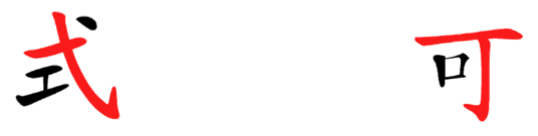
- 半包围结构的字,并非完全按照笔顺取码,而是构件优先。如:
“式”按笔顺其前两笔本来应该为“横横”,但在两笔码中为“横折”;
“可”按笔顺本来应该只取“横”,但在两笔码中为“横竖”。
- For characters with enclosing components, the chords are not determined strictly according to stroke order, but rather by treating constituent components as a unit. For example:
式 would typically have 一一 as its first two strokes, but in the two-stroke system it would be written 一乛.
可 would have only 一 when following stroke order, but in the two-stroke system it would be written 一丨.
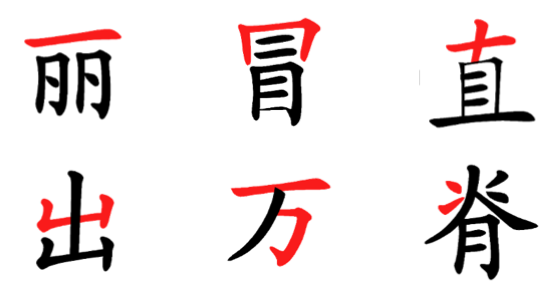
- 有明显界线的字视为合体字,并以该界线拆分。如:
“丽”的首部件只有一横。
“冒”的前两笔为竖折。
“直”的前两笔为横竖。
“出”的前两笔为折竖。
“万”的前两笔为横折。
“脊”的前两笔为点横。
“〇”的笔画为折。
- Characters containing distinct boundaries are treated as composite characters, and are decomposed according to those boundaries. For example:
The initial component of 丽 is 一.
The first two strokes of 冒 are 丨 乛.
The first two strokes of 直 are 一丨.
The first two strokes of 出 are 乛丨.
The first two strokes of 万 are 一乛.
The first two strokes of 脊 are 丶一.
The only stroke of 〇 is 乛.
三、两笔选重
用两笔码进行字词选重时, 可以像部首码或首尾码那样手动触发(加统一功能键 LN) ,也可以像声调码那样自动触发(不加任何功能键) 。下面分别举例说明如何用单笔画、双笔画、字根进行字词选重。
1. 单字选重
【示例一】用单笔画“横”筛选“丽”。
第一击:左手录入“丽”的音节码,目标字不是首选项;
第二击 • 手动触发:左手录入单笔画“横”的编码 RHAN,同时右手按功能键 LN。候选区会显示所有读音为 li、两笔码首部件为“横”的单字,其中“丽”的字频最高并排在首位。
第二击 • 自动触发:左手或右手录入单笔画“横”的编码 RHAN,不加任何功能键。候选区同样会显示所有读音为 li、两笔码首部件为“横”的单字,其中“丽”的字频最高并排在首位。
>丽 郦 逦 鹂 鬲
可见,手动触发和自动触发的效果一样,但后者明显更加简洁高效。所以建议大家直接使用自动触发方式,后面的例子我们也将只介绍这种方式。
3. Two-Stroke Disambiguation
When using two-stroke chords to disambiguate characters and phrases, the process can be triggered manually, like with component and head-and-tail chords (with the :LN designator), or automatically without needing additional designators, like with tone chords. The examples below demonstrate using single strokes, double strokes, and components to resolve ambiguities.
1. Character Disambiguation
Example 1: Select 丽 using the single-stroke 一.
In the first stroke, write 丽 phonetically (li:), the target is not an option;
Second stroke (manual trigger): write the chord for 一 which is RHAN with your left hand, and the designator :LN with your right hand (RHAN:LN). This returns all characters pronounced li whose initial component is 一; among these, 丽 ranks first on frequency.
Second stroke (automatic trigger): alternatively, write the chord for 一 with either hand, without the designator. This also returns all characters pronounced li whose initial component is 一, and again, 丽 ranks first.
>丽 郦 逦 鹂 鬲
As you can see, the results of manual and automatic triggering are identical, but the latter is clearly more efficient. We recommend using automatic triggering, and the following examples will exclusively focus on that approach.
I L :
R H A N : L N 丽
I L :
R H A N : 丽
I L :
: R H A N 丽
【示例二】用双笔画“横折”对“医”进行选重。
第一击:左手录入“医”的音节码,目标字不是首选项;
第二击: 左手或右手录入双笔画“横折”的编码 IHLOG。候选区会显示所有读音为 yi、两笔码首部件为“横折”的单字,其中“医”的字频最高并排在首位。
>医 夷 弋 轶 翳
Example 2: Select for 医 using its first two strokes, 丨乛.
In the first stroke, write 医 phonetically (yi:).
In the second stroke, write the chord for 丨乛, which is IHLOG, with either hand. This returns all characters pronounced yi whose first two strokes are 丨乛; of these, 医 is most frequent and ranks first.
>医 夷 弋 轶 翳
I :
I HL OG : 医
I :
:I HL OG 医
【示例三】用字根“口”对“嗜”进行选重。
第一击:左手录入“嗜”的音节码,目标字不是首选项;
第二击:左手或右手录入字根“口”的编码 IRNG。候选区会显示所有读音为 shi、两笔码首部件为“口”的单字,其中“嗜”的字频最高并排在首位。
>嗜 𡅎 噓
Example 3: Select for 嗜 using its initial component, 口.
In the first stroke, write 嗜 phonetically (shi:).
In the second stroke, write the chord for 口, which is IRNG, with either hand. This returns all characters pronounced shi whose initial component is 口; of these, 嗜 is most frequent and ranks first.
>嗜 𡅎 噓
IB L :
I R N G : 嗜
IB L :
:I R N G 嗜
注意:用两笔码进行单字选重时,只有异步追加式,没有同步直加式(参考第七章第二节《异步与同步》)。因为后面即将介绍的两笔直击字,就相当于同步直加式的第一击。
Note that when using two-stroke chords to disambiguate homophones, only the sequential method is available; the parallel method is not supported (see Chapter 7, Section 2: "Sequential and Parallel Input"). This is because two-stroke direct-input characters, which will be introduced shortly, effectively serve as the first stroke for parallel input.
2. 词语选重
【示例一】用“旧”的两笔码首部件(单笔画“竖” )筛选“旧时”。
第一击:双手录入“旧时”的音节码,目标词不是首选项;
>就是 救市 九十 旧时 旧事 旧式
第二击 • 首字选重:左手录入单笔画“竖”的编码 RHOU。候选区会显示所有读音为jiu’shi、首字的两笔码首部件为“竖”的词语,其中“旧时”的词频最高并排在首位。
>旧时 旧事 旧式 旧诗 旧识 旧市
2. Phrase Disambiguation
Example 1: Select for 旧时 using the two-stroke chord of 旧, 丨.
In the first stroke, write 旧时 phonetically (jiu:shi). The target word is not the first candidate.
>就是 救市 九十 旧时 旧事 旧式
Second stroke (head chord): write the chord for 丨, which is RHOU, with the left hand. This returns all words pronounced jiushi whose first character has an initial component 丨; of these, 旧时 ranks first.
>旧时 旧事 旧式 旧诗 旧识 旧市
BD U O :IB L
R H U O : 旧时
【示例二】用“语”的两笔码首部件(双笔画“点折” )筛选“寄语”。
第一击:双手录入“寄语”的音节码,目标词不是首选项;
第二击 • 尾字选重:右手录入双笔画“点折”的编码 IBHOG。候选区会显示所有读音为 ji’yu、尾字的两笔码首部件为“点折”的词语,其中“寄语”的词频最高并排在首位。
Example 2: Select for 寄语 using the two-stroke chord of 语, 丶乛.
In the first stroke, write 寄语 phonetically (ji:yu).
Second stroke (tail chord): write the chord for 丶乛, which is RHOU, with the right hand. This returns all words pronounced jiyu whose last character has an initial component 丶乛; of these, 寄语 ranks first.
【示例三】分别用字根“日”和“木”筛选“时机”。
第一击:双手录入“时机”的音节码,目标词不是首选项;
第二击 • 首字选重:左手录入“时”的两笔码首部件(字根“日” )的编码 IRAN。候选区会显示所有读音为 shi’ji、首字的两笔码首部件为“日”的词语,其中“时机”的词频最高并排在首位。
第二击 • 尾字选重:右手录入“机”的两笔码首部件(字根“木” )的编码 IHOU。候选区会显示所有读音为 shi’ji、尾字的两笔码首部件为“木”的词语,其中“时机”的词频最高并排在首位。
Example 3: Select for 时机 using components 日 and 木.
In the first stroke, write 时机 phonetically (shi:ji).
Second stroke (head chord): write the chord for 日, which is IRAN, with the left hand. This selects for all words pronounced shiji whose first character starts with 日; of these, 时机 ranks first.
Second stroke (tail chord): write the chord for 木, which is IHOU, with the right hand. This selects for all words pronounced shiji whose last character starts with 日; of these, 时机 ranks first.
IB L : BD
I R A N : 时机
IB L : BD
:I H U O 时机
【示例四】单字选重和双字选重对比演示:卖花→买花→买画→卖画
音节 mai’hua 对应多个词条,都很常见,首选项为“卖花”。
>卖花 买花 买画 卖画 卖化
若想录入的是“买花”,则第二击需要首字选重,即左手按“买”的二笔码首部件(单笔画“折”)的编码 RHOG。
>买花 买画
若想录入的是“买画”,则第二击需要尾字选重,即右手按“画”的二笔码首部件(单
笔画“横”)的编码 RHAN
>买画 卖画
若想录入的是“卖画”,则第二击需要双字选重,即左手按“卖”的二笔码首部件(双笔画“横竖”)的编码 IHLOU,同时右手按“画”的二笔码首部件(单笔画“横”)的编码 RHAN。
>卖画 (横竖:横)
Example 4: Comparing character vs word selection: 卖花, 买花, 买画, 卖画
The syllables maihua have multiple entries, all of which are common; the preferred candidate is 卖花.
>卖花 买花 买画 卖画 卖化
If you want to write 买花, the second stroke requires selecting the first character. Write the chord for 乛, which is RHOG, with your left hand.
>买花 买画
If you want to write 买画, the second stroke requires selecting the last character. Write the chord for 一, which is RHAN, with your right hand.
>买画 卖画
To write 卖画, the second stroke requires disambiguation on both characters. Write the two-stroke chord of 卖, which is 一丨 (IHLOU), with your left hand, and the chord for 一, which is RHAN, with your right hand.
>卖画 (一丨:一)
IB F A :I H G
R H OG : 买花
IB F A :I H G
: R H A N 买画
IB F A :I H G
I HL U O : R H A N 卖画
四、两笔直击
两笔直击字数量巨大,足有万余(重复的只算 1 个)。它与声调直击字同理,只是功能键改成了两笔码。两笔直击字也有“左音右形”和“左形右音”两种打法,下面各举一例进行说明。
两笔直击字示例
4. Two-Stroke Direct Input
There are many two-stroke direct-input characters, numbering over ten thousand (duplicates each counted once). The underlying principle is similar to that of tone-based direct-input characters; the only difference is that the designators are two-stroke chords. There are also two possible patterns—tone on the left, shape on the right and shape on the left, tone on the right—each of which is illustrated below.
Two-Stroke Direct Input Character Example Table
单字
Character |
左手音
Left hand
Syllable |
右手形
Right hand
Shape |
|
左手形
Right hand
Shape |
右手音
Left hand
Syllable |
单字
Character |
| 逗 | dou | 横 一 | 横 一 | dou | 豆 |
| 旧 | jiu | 竖 丨 | 竖 丨 | jiu | 旧 |
| 胤 | yin | 撇 丿 | 撇 丿 | yin | 胤 |
| 氷 | bing | 点 丶 | 点 丶 | bing | 氷 |
| 迅 | xun | 折 乛 | 折 乛 | xun | 卂 |
| 春 | chun | 横横 一一 | 横横 一一 | chun | 蠢 |
| 功 | gong | 横竖 一丨 | 横竖 一丨 | gong | 恭 |
| 砂 | sha | 横撇 一丿 | 横撇 一丿 | sha | 厦 |
| 平 | ping | 横点 一丶 | 横点 一丶 | ping | 平 |
| 式 | shi | 横折 一乛 | 横折 一乛 | shi | 轼 |
| 斐 | fei | 竖横 丨一 | 竖横 丨一 | fei | 翡 |
| 坚 | jian | 竖竖 丨丨 | 竖竖 丨丨 | jian | 监 |
| 帰 | gui | 竖撇 丨丿 | 竖撇 丨丿 | gui | 归 |
| 敞 | chang | 竖点 丨丶 | 竖点 丨丶 | chang | 氅 |
| 岸 | an | 竖折 丨乛 | 竖折 丨乛 | an | 黯 |
| 稗 | bai | 撇横 丿一 | 撇横 丿一 | bai | 拜 |
| 丘 | qiu | 撇竖 丿丨 | 撇竖 丿丨 | qiu | 邱 |
| 斤 | jin | 撇撇 丿丿 | 撇撇 丿丿 | jin | 近 |
| 采 | cai | 撇点 丿丶 | 撇点 丿丶 | cai | 彩 |
| 忽 | hu | 撇折 丿乛 | 撇折 丿乛 | hu | 狐 |
| 床 | chuang | 点横 丶一 | 点横 丶一 | chuang | 疮 |
| 闵 | min | 点竖 丶丨 | 点竖 丶丨 | min | 闽 |
| 煅 | duan | 点撇 丶丿 | 点撇 丶丿 | duan | 断 |
| 灾 | zai | 点点 丶丶 | 点点 丶丶 | zai | 宰 |
| 郎 | lang | 点折 丶乛 | 点折 丶乛 | lang | 朗 |
| 属 | shu | 折横 乛一 | 折横 乛一 | shu | 書 |
| 际 | ji | 折竖 乛丨 | 折竖 乛丨 | ji | 亟 |
| 嫁 | jia | 折撇 乛丿 | 折撇 乛丿 | jia | 驾 |
| 预 | yu | 折点 乛丶 | 折点 乛丶 | yu | 予 |
| 贯 | guan | 折折 乛乛 | 折折 乛乛 | guan | 纶 |
| 铅 | qian | 钅 | 钅 | qian | 钳 |
| 柯 | ke | 木 | 木 | ke | 棵 |
| 治 | zhi | 氵 | 氵 | zhi | 汁 |
| 塘 | tang | 土 | 土 | tang | 趟 |
| 莉 | li | 艹 | 艹 | li | 荔 |
| 暑 | shu | 日 | 日 | shu | 曙 |
| 腹 | fu | 月 | 月 | fu | 肤 |
| 货 | huo | 人 | 人 | huo | 伙 |
| 蹈 | dao | 口 | 口 | dao | 叨 |
| 揭 | jie | 扌 | 扌 | jie | 捷 |