E 迅速记指法方案说明

入门篇

EXun Shorthand Instruction Guide

Introductory Unit

transcribed and translated by Sammi Ta
This document is intended to describe the theory. Sections that are not relevant to the steno theory itself or specifically pertain to features of the software have been omitted for brevity.
  1. Understanding Shorthand
  2. Software
  3. Hardware
    1. Keyboard Familiarization
  4. Basic Writing
    1. Initials
    2. Finals
    3. Writing Syllables
    4. Special Chords

第三章 第五节 熟悉键盘

E 迅速录机共有 26 个按键,左右对称分布,分别由左右手操作,每边各 13 个按键。

3–5 Keyboard Familiarization

The EXun keyboard layout has 26 keys, laid out in two symmetrical sides, 13 keys on each side, operated separately by each hand.
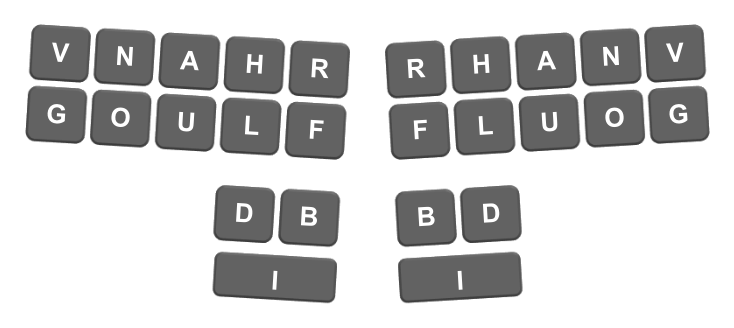
IBDRFHLAUNOVG:IBDRFHLAUNOVG
The EXun system does not have a strict order of keys within each half, but my Plover implementation of the system will use the order above, based on the key order from the thumb to the pinkies. Steno notes below and in the rest of this documentation will follow the same order for consistency.

一、键位识记

左右每边又各分声码区和韵码区,这样既保证了双手能够同时敲击键盘,又保证了每只手能通过声韵相拼独立打出一个汉字,从而实现双手协同操作时一击打出两个汉字。E迅速记机的打字速度之所以特别快,基本原理就在于此。

1. Keyboard Layout Familiarization

The left and right side are each further divided into an initial bank and a final bank. This design ensures that both hands can hit the keys at once, while also allowing each hand to write a complete Chinese character independently by combining the initial and final on each side. It is possible to write two characters in one keystroke if both hands are used. This is why the EXun system is especially fast.
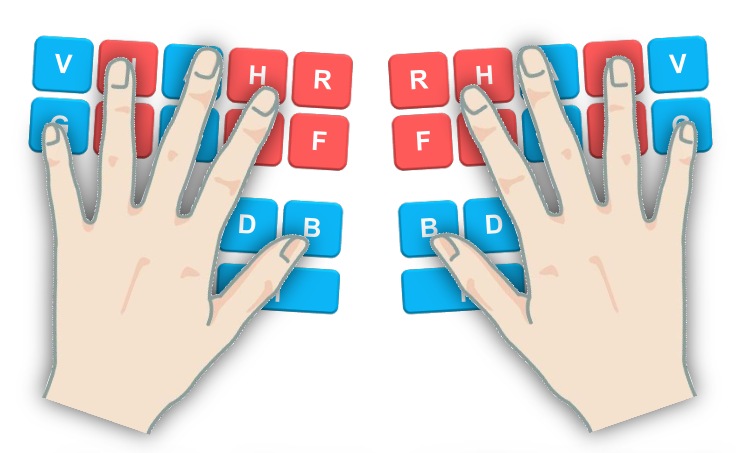
二、五指分工

2. Finger Assignments

不击键时,五指要始终保持在基准键位上,分别为:

请注意,要用指尖外侧面接触键面,手腕悬空,手指半屈,手掌及手腕不要压在键盘或腿上。

When not actively hitting keys, your fingers should stay in the home position, which is as follows:

Remember to use the outer edge of your fingertips to press the keys. Keep your wrists suspended, your fingers slightly bent, and make sure that your palms and wrists are not resting on the keyboard or your legs.

三、动作要领

练习速记技能是一个比较枯燥的过程,尤其是最初的编码学习阶段,必须要经过一段时间苦练,才能达到应用自如的程度。练习速记虽然没有捷径,但却是有方法的。在刚开始练习时,切忌不要求快,必须把每个指法的按键动作分解开,认真分析按下、抬起、转换等各个动作的最佳方式,确保动作幅度最小、最优雅、最省力、最流畅、最连贯,实现一连串击键动作如行云流水般一气呵成,这样方能为以后的提速打下良好基础。一个坏习惯养成可能很难,但如果等它养成后再想改正,那就更难了。所以大家开始练习时一定要用心去理解标准动作设计的合理性,认真分析自己的动作是否合理、连贯。

并击击键的动作不同于我们平时在键盘上的按键动作,关键需要做到以下几点:

经过对上百名速录师(从初级到高级都有)的击键动作进行科学统计分析,我们发现优秀的速录师和一般速记员在指法动作上有明显区别。下面所列的几种典型错误动作,会对以后的提速产生严重影响,请大家务必理解和避免。

手指手臂僵硬无弹性——手指手臂始终处于紧张状态,初学者尤其容易犯这个毛病,打不了多久就手臂酸痛了。正确的击键动作一定要注意发力和放松的节奏与方法。

手腕和肘部转动——部分学员由于手小,或者小指、无名指力量不够,就借助腕部转动的力量来弥补,这样会导致肘部张合、肩关节运动,甚至整个身体左右晃动。由于运动幅度大,还会严重限制击键速率的提高。正确的方法应该是类似弹钢琴按和弦那样的方式,即上臂自然放松靠近身体两侧,手腕除了因应指法必要的水平方向运动外尽量保持不动,靠手指发力和前臂直上直下运动的力量来上下击键,手腕的力量主要用于保持手型在击键时不变。一般来说,手比较大的学员,可使用前臂和手腕基本不动、手掌和手指发力的方式来击键,这样运动幅度最小,击键频率也容易达到较高水平;而手比较小的学员,适合使用指法手形固定、前臂上下小幅运动的方式来击键,通过一段时间训练后,击键频率也能达到足够高的水平。

手指平伸张开——手指平伸张开铺在按键上,击键时手指需先收拢抬起。这是个完全多余的动作,正确的基准手形应该是半握空心拳的状态,五指略微分开,轻触基准键位。

手形不固定——对于同样的音节码,击键时手指与键帽接触的位置不确定,最常见的表现就是频繁丢键(少键)或带键(多键)。正确做法应该是将每个音节码的指法、以及音节码之间转换的动作都通过练习固定下来,每次触键时手指和键帽保持基本相同的位置,这样才能形成真正的“手指记忆”效果。

击键运动幅度太大——手抬起很高后按下,运动距离过长,这样会对提高击键频率产生障碍。要达到高速击键,手的动作幅度必须尽量小。

击键力量太大——击键很用力,声音很大。这也是完全没必要的,无论标准键盘还是专业速记机,按键所需力量都不大,轻轻按下就能完成,这样既能提高击键频率,还能减小击键声音。

摸键归位——表现为一组指法完成后,找不到基准键位,需要摸一下按键让手指归位,然后才开始下一组指法的击键。应通过手指间的相对感觉来记忆按键位置,当按键记熟后,不仅不能摸键,连归位的动作都不能有。

击键节奏混乱——熟练自如的并击击键声音是整齐并富有节奏感的,若在提高击键频率时听到噼里啪啦的混乱击键声,就应及时降低击键速度, 待动作稳定后再尝试更高的速度。

3. Proper Technique

Practicing stenotype is a very tedious process, especially very early on while learning theory, and requires a period of training until you can reach proficiency. While there are no shortcuts to mastery, there are some methods to follow. When you first start practicing, it is important to resist the urge to rush, instead taking your time with each stroke to ensure that your fingers are moving as smoothly, and minimally as possible. This lets you write even entire sentences in a seamless flow, which lays a solid foundation for increasing your speed later on. Forming a bad habit can be hard, but correcting it after that can be even harder, so as you begin your study, you should make an effort to understand these movements and analyze whether your own actions are accurate.

The technique for pressing multiple keys at once differs from the typing technique on a conventional keyboard. The key requirements are:

Based on a scientific analysis of the keystrokes of hundreds of stenographers between beginner and advanced levels, we have found marked differences in fingering technique between skilled professionals and average stenographers. The typical errors listed below can severely affect your ability to increase writing speed, so understanding and avoiding them is crucial.

Stiff and rigid fingers and arms: The fingers and arms are constantly tensed, which leads to aches after only a short time. Beginner writers are especially prone to this. Proper technique requires close attention to the rhythm and method of applying force.

Wrist and elbow rotation: Some students with smaller hands or whose pinky and ring fingers aren't particularly strong attempt to compensate by rotating their wrists. This means the elbows flare outward, which causes shoulder movement and could result in the entire body moving from side to side. Excessive motion severely slows down your writing. Steno writing should look like piano playing: upper arms remain relaxed and positioned close to the sides of the body; wrists remain stationary, only moving as needed to write specific chords; while the keystrokes are executed by moving the forearms up and down. The wrists must maintain a consistent shape throughout the process. Students with larger hands may adopt a position where the forearms and wrists remain stationary, relying instead on the palms and fingers to execute the keystrokes; this approach minimizes the range of motion and is ideal for reaching high writing speeds. Conversely, students with smaller hands are better suited to a technique with fixed finger placement and hand shape, combined with slight vertical movement of the forearms, which can also enable them to achieve high writing speeds over time with consistent practice.

Fingers flat and splayed out: The fingers are retracted and lifted when hitting a key. This movement is unnecessary; the hand position should have the five fingers slightly parted and touching the keys in the home position.

Inconsistent finger positions: When writing the same chord, the point of contact between the finger and the keycap varies. This usually manifests as frequently missed keys or accidental added keys. The correct approach involves practising the fingering for each chord, as well as the transitions between then, such that the point of contact remains identical with every stroke, in order to train muscle memory.

Excessive motion: lifting the hands before stroking, results in the hands travelling an unnecessary long distance, hindering writing speed. To achieve high speeds, movements must be kept to an absolute minimum.

Excessive force: striking the keys too hard is unnecessary, whether using a keyboard or a steno machine. The amount of force needed to actuate keys is minimal. This not only increases writing speed but reduces the noise produced by keystrokes.

Finger repositioning: the inability to locate home position immediately after writing a sequence of keystrokes, resulting in feeling for the keys to guide the fingers back to it. Instead learn the locations of the keys based on the relative positions of the fingers. Once you've learned the key layout thoroughly, you should not need to physically search for the keys.

Irregular rhythm: Fluid writing is uniform and rhythmic; if it turns chaotic and clattering when you increase speed, slow down immediately, and wait until your strokes are more stable before attempting a higher speed again.

第四章 基础编码

E 迅速记的编码方案是以汉语拼音方案为基础而设计的,包括声码、韵码、音节码、特定码四种,在配套的学习程序中均有相应的训练脚本和词汇素材,下面仅按码表形式分别予以介绍。

第一节 声码

声码就是汉语拼音方案中声母对应的编码,共计 21 个,如下表所示:

4 Basic Writing

EXun outlines are based on the Hanyu Pinyin system, and is composed of four categories: initial chords, final chords, syllable chords, and special chords. The learning software that accompanies this book features training material for each category, but below they are presented in the form of reference tables.

4–1 Initial Chords

An initial chord refers to the chord corresponding to an initial consonant within the Hanyu Pinyin system. There are 21 such chords:

声母
Initial
声码
Initial
Chord
自成音节
Independent
Syllable
声母
Initial
声码
Initial
Chord
自成音节
Independent
Syllable
bB dDde
pBR tDHte
mBFme nDLne
fF lLle
gHLge jBD
kRFke qBDH
hHhe xBDL
zhBHzhe zDRze
chBLche cDRFce
shBLshe sDFse
rRre

与汉语拼音方案中的声母和韵母有所不同,E 迅速记的声码和韵码既能相互拼缀,又可单独使用,单独使用时所代表的音节就是自成音节。实际上,在汉语拼音方案中也有部分音节仅由韵母构成,也即“零声母”音节,比如:安(an)、嗯(en)等。速记方案中的声韵码自成音节,亦同此理。

Unlike the initials and finals found in Hanyu Pinyin, the initial and final chords in EXun Shorthand can not only be combined with each other but can also be used on their own; when used in isolation, they represent full syllables. In fact, the Hanyu Pinyin system contains certain syllables only composed of a final, also called zero-initial (零声母) syllables, such as 安 an and 嗯 en. The ability of initial and final chords to function as full syllables operates on this same principle.

声码记忆规律:

Rules for memorizing initial chords:

第二节 韵码

韵码就是汉语拼音方案中韵母对应的编码,共计 27 个,如下表所示:

4–2 Final Chords

Final chords correspond to finals in the Hanyu Pinyin system. There are 27 of them:

韵母
Final
韵码
Final
Chord
自成音节
Independent
Syllable
谐音字
Homophone
韵母
Final
韵码
Final
Chord
自成音节
Independent
Syllable
谐音字
Homophone
aAa iaIAya
ai
enNen inINyin
uang
unGwen ünIGyun
ua
uo, oOwo, o iongIOyong
ong
uUwu üIUyu
uai
anANan ianIANyan
ouOUou iuIOUyou
aoAOao iaoIAOyao
engNGeng ingINGying
e/eiOGe, ei ieIOGye
angANGang iangIANGyang
uiUOGwei üeIUOGyue
uanAOGwan üanIAOGyuan
e
(none)
iIyi

汉语拼音方案中的韵母共有 34 个,其中 e 已经融入声码的自成音节中,剩余 33 个韵母则分别由以上 27 个韵码所表示。下面介绍韵码的记忆规律:

The Hanyu Pinyin system contains a total of 34 finals, of which the final e is incorporated into independent syllables represented by the initial chords. The remaining finals are represented by the 27 chords above. Below are the patterns for memorizing these chords:

第三节 音节码

音节码就是汉语拼音方案中音节对应的编码,共计 440 个,其中符合声韵拼合规律的常规音节码 399 个(包括自成音节的 15 个声码和 27 个韵码)、不符合声韵拼合规律的特殊音节码 9 个、指法进行了简化的简易码 30 个、具有特定码性质的音节码 2 个。下面按声母区块分组呈现,自成音节的声码和韵码则不再列出。

3 Syllable Chords

Syllable chords are chords corresponding to each of the syllables defined in the Hanyu Pinyin system. There are 440 such codes, consisting of 399 regular syllables that follow initial-final combination rules (including 15 initial chords and 27 final chords that can be used as independent syllables); 9 special chords that deviate from these rules; 30 simplified chords featuring streamlined fingering patterns; and 2 that essentially act as special-purpose chords. The chords are presented below, grouped by initial; the independent initial and final chords are not listed here.

For a complete list of all syllable chords, see the Syllable Table appendix.

一、b p m f 系列

1. b, p, m, f initials

B A ba B R A pa B F A ma F A fa
B U bu B R U pu B F U mu F U fu
B N ben B R N pen B F N men F N fen
B O bo B R O po B F O mo F O fo
B A N ban B R A N pan B F A N man F A N fan
B R U O pou B F U O mou F U O fou
B OG bei B R OG pei B F OG mei F OG fei
B A O bao B R A O pao B F A O mao
B N G beng B R N G peng B F N G meng F N G feng
B A N G bang B R A N G pang B F A N G mang F A N G fang
IB bi IB R pi IB F mi
IB A bai IB R A pai IB F A mai
IB N bin IB R N pin IB F N min
IB A N bian IB R A N pian IB F A N mian
IB OG bie IB R OG pie IB F OG mie
IB A O biao IB R A O piao IB F A O miao I F A O fiao
IB N G bing IB R N G ping IB F N G ming
IB F U O miu

绿色字体的 7 个音节有简易码。具体如下:

The 7 syllables highlighted in green have alternate chords:

B RF pi
B RF A pai
B RF N pin
B RF A N pian
B RF OG pie
B RF A O piao
B RF N G ping

二、d t n l 系列

2. d, t, n, l initials

D A da D H A ta D LA na LA la
D U du D H U tu D L U nu L U lu
D N den D L N nen
D O duo D H O tuo D L O nuo L O luo/lo
D G dun D H G tun D L G nun L G lun
D A N dan D H A N tan D LA N nan LA N lan
D U O dou D H U O tou D L U O nou L U O lou
D OG dei D H OG tei D L OG nei L OG lei
D A O dao D H A O tao D LA O nao LA O lao
D N G deng D H N G teng D L N G neng L N G leng
D A N G dang D H A N G tang D LA N G nang LA N G lang
D A OG duan D H A OG tuan D LA OG nuan LA OG luan
D U OG dui D H U OG tui
I D di I D H ti I D L ni I L li
I D A dai I D H A tai I D LA nai I LA lai
I D O dong I D H O tong I D L O nong I L O long
I D A N dian I D H A N tian I D LA N nian I LA N lian
I D OG die I D H OG tie I D L OG nie I L OG lie
I D A O diao I D H A O tiao I D LA O niao I LA O liao
I D N G ding I D H N G ting I D L N G ning I L N G ling
I D U O diu I D L U O niu I L U O liu
I D L N nin I L N lin
I D L U I L U
I D LA N G niang I LA N G liang
I D L U OG nüe I L U OG lüe

luo 和 lo 共享一个音节码。

绿色字体的 7 个音节具有简易码,具体如下:

Note that luo and lo share the same chord.

The 7 syllables highlighted in green have alternate chords:

D HL ti
D HLA tai
D HL O tong
D HLA N tian
D HL OG tie
D HLA O tiao
D HL N G ting

三、g k h j q x 系列

3. g, k, h, j, q, x initials

HLA ga RF A ka H A ha
HL N gen RF N ken H N hen
HL G gun RF G kun H G hun
HL O guo RF O kuo H O huo
HL U gu RF U ku H U hu
HLA N gan RF A N kan H A N han
HLA O gao RF A O kao H A O hao
HL U O gou RF U O kou H U O hou
HL OG gei RF OG kei H OG hei
HL N G geng RF N G keng H N G heng
HLA N G gang RF A N G kang H A N G hang
HL U OG gui RF U OG kui H U OG hui
HLA OG guan RF A OG kuan H A OG huan
I HLA gai I RF A kai I H A hai
I HL N guang I RF N kuang I H N huang
I HL G gua I RF G kua I H G hua
I HL O gong I RF O kong I H O hong
I HL U guai I RF U kuai I H U huai
BD ji BD H qi BD L xi
BD A jia BD H A qia BD LA xia
BD N jin BD H N qin BD L N xin
BD G jun BD H G qun BD L G xun
BD O jiong BD H O qiong BD L O xiong
BD U ju BD H U qu BD L U xu
BD A N jian BD H A N qian BD LA N xian
BD A O jiao BD H A O qiao BD LA O xiao
BD U O jiu BD H U O qiu BD L U O xiu
BD OG jie BD H OG qie BD L OG xie
BD N G jing BD H N G qing BD L N G xing
BD A N G jiang BD H A N G qiang BD LA N G xiang
BD U OG jue BD H U OG que BD L U OG xue
BD A OG juan BD H A OG quan BD LA OG xuan

四、zh ch sh r 系列

4. zh, ch, sh, r initials

B H zhe B HL che B L she R re
B H A zha B HLA cha B LA sha
B H N zhen B HL N chen B L N shen R N ren
B H G zhun B HL G chun B L G shun R G run
B H O zhuo B HL O chuo B L O shuo R O ruo
B H U zhu B HL U chu B L U shu R U ru
B H A N zhan B HLA N chan B LA N shan R A N ran
B H U O zhou B HL U O chou B L U O shou R U O rou
B H OG zhei B L OG shei
B H A O zhao B HLA O chao B LA O shao R A O rao
B H N G zheng B HL N G cheng B L N G sheng R N G reng
B H A N G zhang B HLA N G chang B LA N G shang R A N G rang
B H U OG zhui B HL U OG chui B L U OG shui R U OG rui
B H A OG zhuan B HLA OG chuan B LA OG shuan R A OG ruan
IB H zhi IB HL chi IB L shi I R ri
IB H G zhua IB HL G chua IB L G shua I R G rua
IB H O zhong IB HL O chong I R O rong
IB H A zhai IB HLA chai IB LA shai
IB H U zhuai IB HL U chuai IB L U shuai
IB H N zhuang IB HL N chuang IB L N shuang

红色字体的 zhei 和 shei 各只对应一个汉字,分别为“这”和“谁”,而这两个字又都是多音字, “这”还可以通过 zhe 打出来,“谁”还可以通过 shui 打出来,所以 zhei 和 shei 的音节码 BHOGBLOG 实际上是将这两个字唯一化了,具有特定码性质。

绿色字体的 9 个音节具有简易码,具体如下:

The chords for zhei and shei, highlighted in red, each correspond to exactly one character, specifically 这 and 谁 respectively. Since both of these characters have multiple readings (这 can also be written with zhe, and 谁 with shui), the syllable chords BHOG and BLOG can uniquely identify these two characters and can function as special chords.

The 9 syllables highlighted in green have alternate chords:

B F L zhi
B F LA zhai
B F L N zhuang
B F L G zhua
B F L O zhong
B F L U zhuai
IB A N G chang
IB U OG chui
IB A OG chuan

五、z c s 系列

5. z, c, s initials

DR A za DRF A ca D F A sa
DR N zen DRF N cen D F N sen
DR G zun DRF G cun D F G sun
DR O zuo DRF O cuo D F O suo
DR U zu DRF U cu D F U su
DR A N zan DRF A N can D F A N san
DR A O zao DRF A O cao D F A O sao
DR U O zou DRF U O cou D F U O sou
DR N G zeng DRF N G ceng D F N G seng
DR A N G zang DRF A N G cang D F A N G sang
DR U OG zui DRF U OG cui D F U OG sui
DR A OG zuan DRF A OG cuan D F A OG suan
DR OG zei
I DR zi I DRF ci I D F si
I DR A zai I DRF A cai I D F A sai
I DR O zong I DRF O cong I D F O song

绿色和红色字体的 7 个音节具有简易码,具体如下:

The 7 syllables highlighted in green have alternate chords:

D F L zi
D F LA zai
D F L O zong
IB L O cong
I D A N G cang
I D U OG cui
I D A OG cuan

六、特殊音节码

以下 9 个音节码是特殊安排的,它们并不符合声韵拼合的规律,所以需要单独记忆。

6. Special Syllable Chords

The 9 syllable chords below do not follow the conventional rules of combining initials and finals and should be memorized individually.

R A er
I D G dia
I L G lia
I F O weng
I F G wa
I F N wang
I F U wai
I F A ai
I F U O yo

第四节 特定码

所谓特定码,是指独立于音节码之外,专门为某些特殊字词规定的编码。特定码是与音节码平行的概念,它不是单独定义在左手或右手上,更不是双手的组合,而是两边都有,左右对称,双手均可独立操作,使用起来跟音节码没有二致。而且与音节码并行不悖,二者可以混合操作,互不干扰。

一、独孤九键

除了前面提到的 BHOG(这)和 BLOG(谁)之外,我们还设置了七个特定码:

4–4 Special Chords

Special chords are a system separate from syllable chords, designated for certain specialized characters or words. They exist in a separate space from syllable chords; they are not solely for the left or right hand, nor are they a combination of both, but rather are present on both sides in a symmetrical arrangement. Either hand can write them independently, and they can be used in the exact same way as syllable chords. Furthermore, they can be mixed with syllable chords without conflict.

1. The Nine Words

In addition to the previously mentioned BHOG (这) and BLOG (谁), we have 7 more special chords:

F L
R H
B L OG 谁/誰
B H OG 这/這
F A OG
B A OG
IB U
IB O
IB G

例:

  1. “哪个”若双手都用音节码录入则需要选择,但若左手使用特定码则一击便出。
  2. “那里”若双手都用音节码录入则需要选择,但若左手使用特定码则一击便出。
  3. “她的”若双手都用音节码录入则无此词,但若左手使用特定码则一击便出。
  4. “它们”若双手都用音节码录入则需要选择,但若左手使用特定码则一击便出。

Examples:

  1. If you write 哪个 normally with syllable chords (na:ge), further disambiguation is needed; however, if the left hand is written with a special code, it can be done with a single keystroke.
  2. If you write 那里 normally with syllable chords (na:li), further disambiguation is needed; however, if the left hand is written with a special code, it can be done with a single keystroke.
  3. If you write 她的 normally with syllable chords (ta:de), that is not a valid entry; however, if the left hand is written with a special code, it can be done with a single keystroke.
  4. If you write 它们 normally with syllable chords (ta:men), further disambiguation is needed; however, if the left hand is written with a special code, it can be done with a single keystroke.
F A OG : HL 哪个 (FAOG:ge)
B A OG :I L 那里 (BAOG:li)
IB U : D 她的 (IBU:de)
IB G : B F N 它们 (IBG:men)
特别提示:在E 迅速记体系里编码中的冒号为左右分隔符
Special Note: In the E-Xun system, the colon : serves as a left-right separator.

二、右手之某

双手并击时,若左手打的是百家姓的音节之一,右手打的是 yo 的音节码 FIOU,则右手 FIOU 会变身为“某”的特定码。

譬如:左手录入 an 的音节码,同时右手录入 FIOU,则会输出“安某”。

2. Right-hand 某

If you write one of the syllables from the Hundred Family Surnames (百家姓) on the left hand, and the syllable chord FIOU (yo) on the right hand, the right-hand input is translated into the special code for the character 某.

For example, if you write the syllable chord for an on the left and FIOU on the right at the same time, the output will be 安某.

A N :I F U O 安某 (an:FIOU)

之所以这么做,是因为 yo 很少和其他音节组合使用,与其白白浪费掉,不如加以重复利用。将其右手编码当做“某”的特定码,可有效减少“×某”的重码率,将其一击打出,从而大大提高击键效率和录入速度。

This is because yo rarely appears in combination with other syllables; it is better to reuse it than let it go to waste. By designating its use on the right hand as a special code for 某, you can reduce the conflict rate for combinations involving ×某, allowing the character to be entered with a single keystroke, boosting keystroke efficiency and writing speed.

三、汉字数字

汉字数字可用常规音节码录入,但用这种方法每个汉字数字都需要选择,非常不便。故此,我们为十个汉字数字分别设置了如下特定码。

双手均可 左手小写 右手大写 单手单数 双手双数

3. Chinese Numerals

Chinese numerals can be written using standard syllable chords, but that requires selecting each individual character which is very inconvenient. Thus, we have assigned the following special chords for each of the ten numerals:

Use the left hand for conventional numerals (小写) and the right hand for financial numerals (大写); use a single hand for one digit, or both hands for two digits.
F LA 五 伍
F L U 六 陆
F L N 七 柒
F L O 八 捌
F L G 〇 零
I F LA 一 壹
I F L U 二 贰
I F L N 三 叁
I F L O 四 肆
I F L G 九 玖

很显然,十个数字都含有公共编码 FL,如果去掉公共编码,则剩余部分与文本数字的右手后区编码完全一致,详见第十五章第一节。此外,汉字数字除了上述特定码打法,还有一种直击打法,详见第八章第一节

譬如:录入“十件”时若双手都用音节码,则需翻页才能找到,但若左手使用特定码则一击便出。即只要打 FLAN:jian,就能一击录入“十件”。

除了以上 10 个数字,还有 16 个与之配套的特定码字词,它们共同构成了一套汉字数字系统。如下表所示:

All ten numerals share the common chord FL. If this common chord is removed, the remaining keys correspond to the right-hand chords of the textual digits; refer to Chapter 15, Section 1 for details. In addition to the special chords above, Chinese numerals can also be written with direct input; refer to Chapter 8, Section 1.

For example, when writing 十件, if you rely on syllable chords for both hands, you will need to disambiguate further; however, if you write 十 with a special chord, it can be written in one keystroke. In other words, writing FLAN:jian translates to 十件 instantly.

In addition to the 10 numerals above, there are 16 special words, completing the system of Chinese numerals:

F LA N 十 拾
F L U O 百 佰
F LA O 千 仟
F L N G 万 萬
F L OG 亿 億
F LAU 百分之 %%
F L NO 千分之 ‰
F LAU O 等于 ==
I F LA N 加 ++
I F L U O 减 --
I F LA O 乘 *×
I F L N G 除 /÷
I F L OG 点 ..
I F LAU 百分比
I F L NO 千分比
I F LAU O
对于有重码的,左手录入第一个,右手录入第二个,键盘数字选择第三个

示例:

For entries with multiple variants, use the left hand for the first option, the right hand for the second option, and your keyboard's number keys for the third.

Example:

I F L N : F LA N 三十
I F LA O :
F LA : F L U O 五百
F LAU O : 等于
I F LA : F L N G 一万
F LA : F LA O 五千